

Accounting, Tax & 1099 Compliance Blueprint
- Revenue Classification: Accurately distinguishing gross voucher sales, prize redemptions, and net operating revenue on financial statements.
- Form 1099-NEC & 1099-MISC Rules: Proper contractor reporting for sub-agents, technicians, and floor staff to prevent IRS audits.
- Commercial Tax Deductions: Maximizing legitimate write-offs for hardware depreciation (Section 179), rent, utilities, and wholesale software margins.
- Cash Transaction Reporting (Form 8300): Navigating federal reporting mandates for cash receipts exceeding $10,000 in single transactions.
- Separate Entity Architecture: Structuring multi-LLC holding frameworks to isolate commercial liabilities from personal assets.
Bookkeeping, Taxes & 1099 Compliance for Independent Sweepstakes Agents & Distributors
As an independent sweepstakes agent or wholesale software distributor, your financial success depends not only on top-line revenue generation but on financial discipline and tax compliance. Because the sweepstakes and amusement gaming sector involves high cash velocity and multi-tier contractor relationships, businesses in this vertical face elevated scrutiny from state tax authorities and the Internal Revenue Service (IRS). Inaccurate revenue reporting, mingling of personal and business funds, or failing to issue proper 1099 contractor forms can result in devastating back taxes, civil penalties, and asset freezes. This professional guide outlines the accounting principles, tax deduction strategies, and 1099 compliance protocols required to build an audit-proof sweepstakes enterprise.
Operational Disclaimer: This guide provides strategic, financial, and operational frameworks for independent sweepstakes agents, distributors, and amusement venue owners. Practices described should be tailored to local municipal and state-level business regulations.
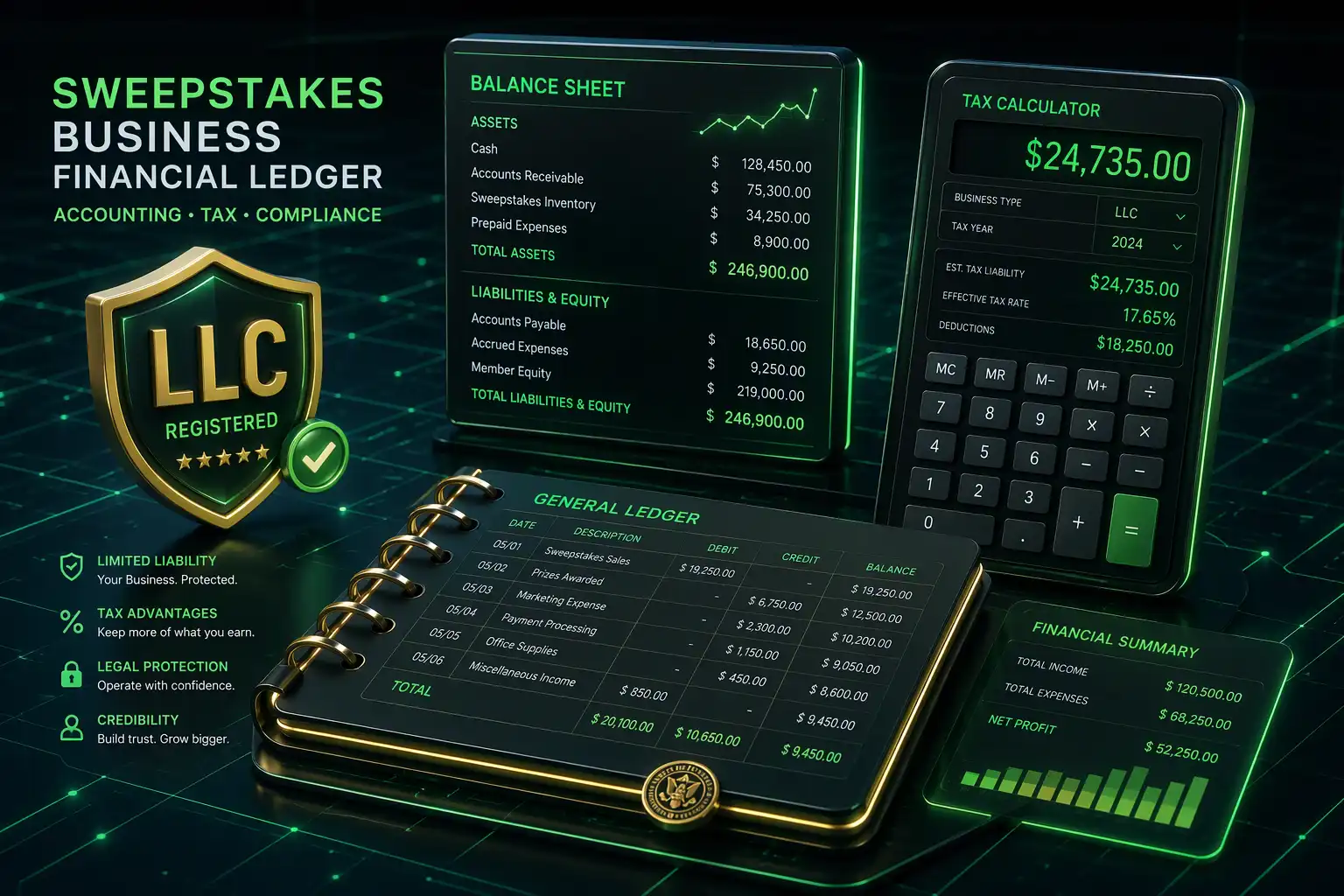
The Accounting Reality: Gross Coin-In vs. Net Operating Revenue
The most common and dangerous bookkeeping error made by novice sweepstakes operators is mischaracterizing gross cash receipts as taxable gross revenue. In an amusement sweepstakes model, cash collected at the counter represents gross customer voucher sales, a substantial portion of which is redistributed as prize redemptions and wholesale software costs.
For accurate bookkeeping under Generally Accepted Accounting Principles (GAAP), financial statements must clearly distinguish:
- Gross Point Sales (Coin-In): Total cash collected from players purchasing play credits.
- Prize Redemptions (Cash-Out): Total cash or prize value awarded to winning players.
- Net Gaming Revenue (Gross Profit): Gross Point Sales minus Prize Redemptions.
- Net Taxable Income: Gross Profit minus Cost of Goods Sold (Wholesale Software Licensing) and Operating Expenses (Rent, Payroll, Utilities, Insurance).
Form 1099 Compliance for Sub-Agents and Independent Contractors
Master distributors who compensate sub-agents, commission route runners, or repair technicians must comply strictly with IRS Form 1099 reporting mandates. Treating sub-agents as employees creates severe payroll tax penalties, while failing to report non-employee compensation leads to contractor misclassification audits.
| Payee Category | IRS Form Required | Annual Reporting Threshold | Required Onboarding Document |
|---|---|---|---|
| Sub-Agent / Route Runner | Form 1099-NEC (Non-Employee Comp) | $600+ in annual commissions | Signed Form W-9 + Contractor Agreement |
| Store Landlord (Commercial Rent) | Form 1099-MISC (Box 1: Rents) | $600+ in annual lease payments | Signed Form W-9 + Commercial Lease |
| Hardware Maintenance Tech | Form 1099-NEC | $600+ in service fees | Signed Form W-9 + Vendor Invoice |
| Floor Cashier / Attendant | Form W-2 (Payroll Employee) | All wages subject to payroll tax | Form W-4 + Form I-9 Verification |
IRS Form 8300: Reporting Large Cash Transactions Over $10,000
Under federal anti-money laundering regulations, any business that receives more than $10,000 in physical cash from a single customer in a single transaction (or related transactions within a 24-hour window) must file IRS Form 8300 within 15 calendar days of the transaction.
Never attempt to structure transactions (e.g., accepting two $6,000 payments across two hours to avoid filing), as ‘structuring’ is a severe federal offense. Train cashiers to request government photo ID and Taxpayer Identification Numbers (SSN/ITIN) whenever a high-roller transaction meets or exceeds federal reporting thresholds.
Maximizing Legitimate Tax Deductions: Section 179 Hardware Write-Offs
Operators can substantially lower their annual tax liabilities by leveraging commercial business deductions under IRS Section 179. Section 179 allows business owners to deduct the full purchase price of qualifying equipment—including arcade cabinets, fish game tables, security surveillance systems, POS terminals, and ergonomic seating—in the tax year purchased rather than depreciating the assets over 5 to 7 years.
Separate Entity Architecture: The Multi-LLC Asset Protection Model
Never operate a sweepstakes business under your personal name or a sole proprietorship. Consult qualified legal counsel to structure a separate multi-entity framework: an Asset Holding LLC that owns the physical hardware and intellectual property, and a separate Operating LLC that manages day-to-day store operations and holds the commercial lease. This architecture shields your valuable capital assets from operating liabilities.
Daily Automated Bookkeeping and Certified CPA Integration
Integrate your POS software with commercial accounting platforms (such as QuickBooks Online or Xero). Perform daily automated bank and drawer reconciliations, archive all digital vendor receipts, and retain a certified public accountant (CPA) experienced in amusement gaming and cash business compliance to prepare quarterly estimated tax filings.
Frequently Asked Questions
Are sweepstakes game winnings reported to players on IRS Form W-2G?
Unlike traditional state-licensed casino gambling, promotional sweepstakes prizes are generally reported under standard promotional prize tax rules (Form 1099-MISC Box 3 for prizes over $600) subject to state-specific statutory guidelines.
Can I deduct the cost of wholesale software point purchases?
Yes. Wholesale software point costs paid to master distributors represent Cost of Goods Sold (COGS) and are 100% tax-deductible against your gross sales.
What is Section 179 depreciation and how does it help my store?
Section 179 allows you to write off the entire purchase cost of new gaming cabinets, POS systems, and security hardware immediately in year one, drastically reducing taxable net income.
Why is mixing personal and business bank accounts dangerous?
Mingling funds pierces the corporate veil of your LLC, exposing your personal home, vehicles, and savings accounts to business liabilities, lawsuits, and severe IRS audit penalties.
Related Resources for Sweepstakes Distributors and Store Owners
To further accelerate your operational performance and expand your agent distribution network, explore our comprehensive business frameworks and technical playbooks:
- MegaSpin Agent & Distributor Portal — Discover enterprise-grade software distribution, competitive commission structures, and multi-tier sub-agent management tools.
- Retail Sweepstakes Launch & Compliance Blueprint — Learn how top store owners optimize hardware selection, player onboarding, and regulatory compliance.