

Expanding your sweepstakes operation across state lines is one of the highest-growth moves available to agents in 2026—and one of the highest-risk if done carelessly. The sweepstakes regulatory landscape in the United States is a patchwork: what is clearly legal in one state can be restricted in another, and enforcement attitudes vary widely. The agents who expand successfully do not treat compliance as an obstacle; they treat it as a competitive advantage. This multi-state compliance playbook gives you the framework to grow your sweepstakes business across borders while staying on the right side of every regulator you serve.
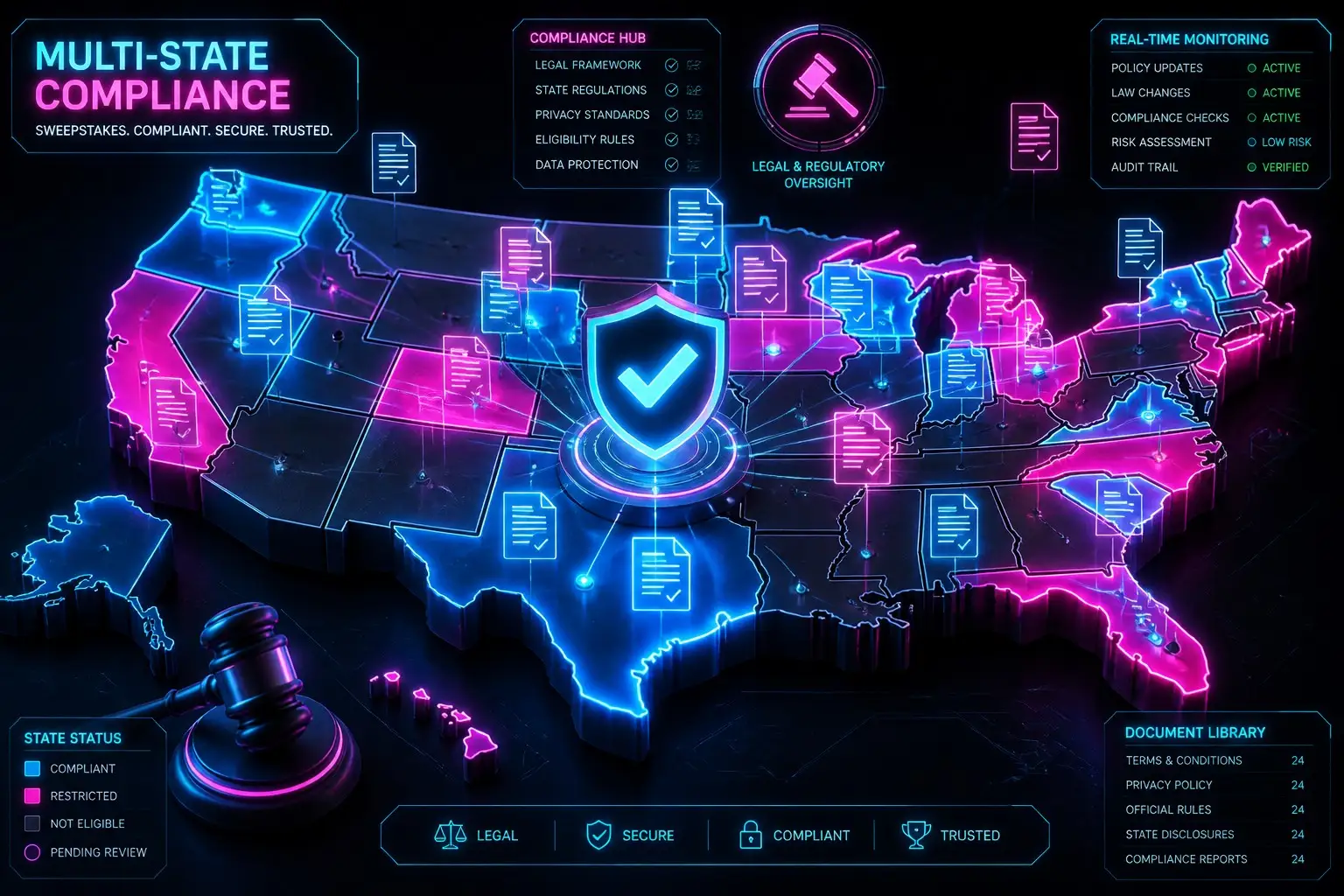
The Patchwork Reality of 2026 Regulation
There is no single federal law governing sweepstakes gaming in the United States; authority rests with individual states. The practical consequences for agents:
- Legal and thriving states: Several states have clear, permissive frameworks where sweepstakes operations are well established.
- Grey-area states: Some states have no explicit ruling, leaving operations legal-but-untested. Agents operate here with caution and local counsel.
- Restricted states: A minority of states restrict or prohibit the model. Operating there risks enforcement action and asset seizure.
The mistake agents make is assuming that what works in their home state transfers elsewhere. It does not. Each new market requires a deliberate compliance assessment before the first credit is loaded.
The Pre-Entry Compliance Audit
Before entering any new state, run this five-point audit:
- Confirm the legal model: Verify that the sweepstakes format you operate is recognized and permitted in the target state.
- Check promotional and prize rules: States regulate how prizes can be promoted, advertised, and awarded. Your marketing playbook may need adjustment.
- Review tax obligations: Every state has its own reporting and tax framework for gaming revenue. Budget for compliance before launch.
- Assess enforcement history: Research whether state authorities have pursued enforcement actions against similar operations. History is a powerful predictor.
- Document your assessment: Write down your legal reasoning and the counsel you consulted. This documentation is your defense if the interpretation is ever challenged.
Technology as Your Compliance Enforcer
Compliance is not only about documents; it is about enforcement at the player level. A modern platform provides the tools to make state-specific rules automatic:
- Geo-Fencing: Automatically block access from restricted states and enforce state-specific features for permitted ones.
- Configurable Limits: Set deposit caps, session limits, and promotional rules per jurisdiction, applied automatically based on player location.
- Reporting Modules: Generate state-specific activity reports for any regulator who requests them.
When your technology enforces the rules, human error cannot create violations. This is why platform selection is a compliance decision, not just a technical one.
Building the Multi-State Documentation System
Expansion multiplies your paperwork. Build a system before you need it: one folder per state, containing your legal analysis, counsel opinions, promotional rules, tax registrations, and activity reports. Update each folder monthly. This discipline serves two purposes: it satisfies any regulator who audits you, and it protects you in the event of a dispute or enforcement inquiry. Documentation is not bureaucracy; it is your liability shield.
The Legal Partner Strategy
For single-state agents, general research may suffice. For multi-state expansion, professional counsel is not optional. Engage a gaming attorney familiar with sweepstakes law in your target states. The cost of counsel is trivial compared to the cost of a compliance failure: frozen assets, seized inventory, and criminal exposure. The right timing to engage counsel is before the first expansion step, not after a regulator contacts you.
Case Pattern: The Two-State Launch That Worked
The difference between a compliant multi-state launch and a regulatory incident is visible in the case patterns of successful 2025-2026 expansions. Consider the operator who expanded from a mature home market into a neighboring state with a different regulatory posture. The operator’s first move was not marketing; it was a structured compliance assessment: written legal analysis of the sweepstakes model in the target state, confirmation of promotional and prize rules, and registration of the appropriate tax obligations. The assessment concluded the model was permitted, with specific constraints on prize advertising that required adjusting the marketing playbook.
The launch itself deployed technology as the enforcement layer. Geo-fencing restricted access to any state where the model was not permitted, and the platform applied the target state’s configuration—deposit limits, session limits, and responsible gaming defaults—automatically based on player location. Because the technology enforced the rules, human error could not create violations. The operator also established the documentation system early: a per-state folder containing the legal analysis, counsel opinions, and monthly activity reports, updated without fail.
The payoff came during a routine audit inquiry. When the target state’s authority requested activity data, the operator produced a complete, organized response within days, including the legal basis for operation and the responsible gaming compliance evidence. The inquiry closed without incident. The operator’s takeaway was consistent with the broader pattern: expansion succeeds when compliance is treated as infrastructure to be built, not as paperwork to be filed after the fact. The two-state launch became the template for further expansion, each subsequent state added using the same disciplined sequence.
Why Compliance Is a Market Advantage
Compliance is often viewed as a constraint, but in the multi-state market it is a structural advantage. Operators with clean compliance posture gain faster access to payment rails, build stronger relationships with partners and regulators, and expand into new states while competitors are still resolving legacy issues. The agents who treat compliance as infrastructure are the ones who can move first when a market opens. Discipline here is not bureaucracy; it is the ticket to every opportunity the market offers.
Frequently Asked Questions
Can I operate nationwide with one set of rules?
No. Each state’s rules govern its players. A truly compliant operation applies state-specific configuration per jurisdiction, enforced through geo-fencing and configurable limits. This is precisely what a professional platform enables.
How often do state regulations change?
Regulatory frameworks are active in 2026, with several states considering legislative updates. Re-run your compliance audit quarterly and subscribe to industry regulatory updates. The agent who monitors changes early can adapt before enforcement shifts.
Can my players play from any state?
Only where the model is permitted. Geo-fencing technology automatically blocks access from restricted states and applies the correct configuration for permitted ones. This is not optional diligence; it is the mechanism that keeps your operation compliant as your player base spans multiple jurisdictions.
How do I budget for multi-state compliance?
Budget for three items: legal counsel for the initial assessment and ongoing advice, technology configuration for geo-fencing and jurisdiction settings, and the administrative cost of maintaining per-state documentation. These costs are modest relative to the revenue a new state can add, and they are the price of entry for compliant expansion.
Do I need separate documentation for each promotional campaign?
Yes. Prize promotions are a primary regulatory focus, and documenting each campaign—the rules, the prizes, the entry method, and the winners—demonstrates good-faith compliance. Keep a campaign record for each promotion in the relevant state folder. This documentation is also valuable marketing evidence of responsible operation.
How do I stay informed about regulatory changes across multiple states?
Build a monitoring routine: subscribe to gaming industry regulatory updates, follow state authority publications, and re-run your compliance audit quarterly. Assign a single person on your team to own regulatory monitoring so changes never go unnoticed. The agents who expand safely are the ones who treat regulation as a live system, not a static document.
What happens if I accidentally serve a player in a restricted state?
Immediate corrective action is essential: stop service, document the incident, and consult counsel. With geo-fencing technology, such incidents should be rare, and a documented remediation process demonstrates good-faith compliance that regulators generally respect.
Building the Compliance Operating Rhythm
Compliance in a multi-state operation is a live system that needs a rhythm. Establish quarterly cycles: at the start of each quarter, review regulatory changes across your operating states and re-run the pre-entry audit for any state you plan to enter; mid-quarter, verify that your technology configuration and documentation remain accurate; at quarter-end, archive the period’s reports and update your risk assessments. This rhythm keeps compliance current without consuming your operational focus. The operators who run this discipline can answer any regulator’s request with confidence, because their compliance posture is continuously maintained rather than reconstructed under pressure.
Conclusion: Growth With Integrity
Multi-state expansion is the clearest path to scale for ambitious sweepstakes agents, and compliance is the gatekeeper of that path. The playbook is straightforward: audit before you enter, enforce with technology, document everything, and engage counsel early. Agents who follow it grow with confidence; agents who skip it gamble with their entire operation. The multi-state sweepstakes market is open, and it rewards the disciplined. Expand deliberately, and your network will grow in every sense of the word.
Building a compliant multi-state operation? Talk to the MegaSpin team about geo-fencing and jurisdiction configuration for your expansion.