

Cash Handling & POS Anti-Loss SOP
- Cash Velocity Risks: Why high-volume sweepstakes cash desks require bank-grade cash handling and reconciliation protocols.
- Counterfeit Defense Matrix: Deploying UV, magnetic, infrared, and spectral bill scanners to stop fake currency cold.
- Two-Key Drop Safes & Float Limits: Restricting active cashier drawer balances to under $1,000 to minimize robbery vulnerability.
- Blind Shift-Close Reconciliations: Eliminating internal theft through computerized blind cash counts and automated disparity logging.
- High-Resolution Cashier Camera Topologies: Camera placement standards that eliminate blind spots over cash drawers and player count trays.
Cash Handling & POS Protocols for Sweepstakes Stores: Anti-Theft, Counterfeit & Shift Audit SOP
In a thriving retail sweepstakes venue, the cashier counter is the epicenter of financial velocity. Handling tens of thousands of dollars in cash daily across voucher purchases, player redemptions, and change transactions creates immense operational risk. Without strict cash management protocols, store owners bleed margin through counterfeit bill acceptance, cashier short-changing, drawer mismanagement, and internal skimming. Establishing bank-grade cash handling protocols, deploying advanced counterfeit detection hardware, and enforcing blind shift-change audits protects your revenue, secures your employees, and ensures every dollar earned reaches your bank account.
Operational Disclaimer: This guide provides strategic, financial, and operational frameworks for independent sweepstakes agents, distributors, and amusement venue owners. Practices described should be tailored to local municipal and state-level business regulations.
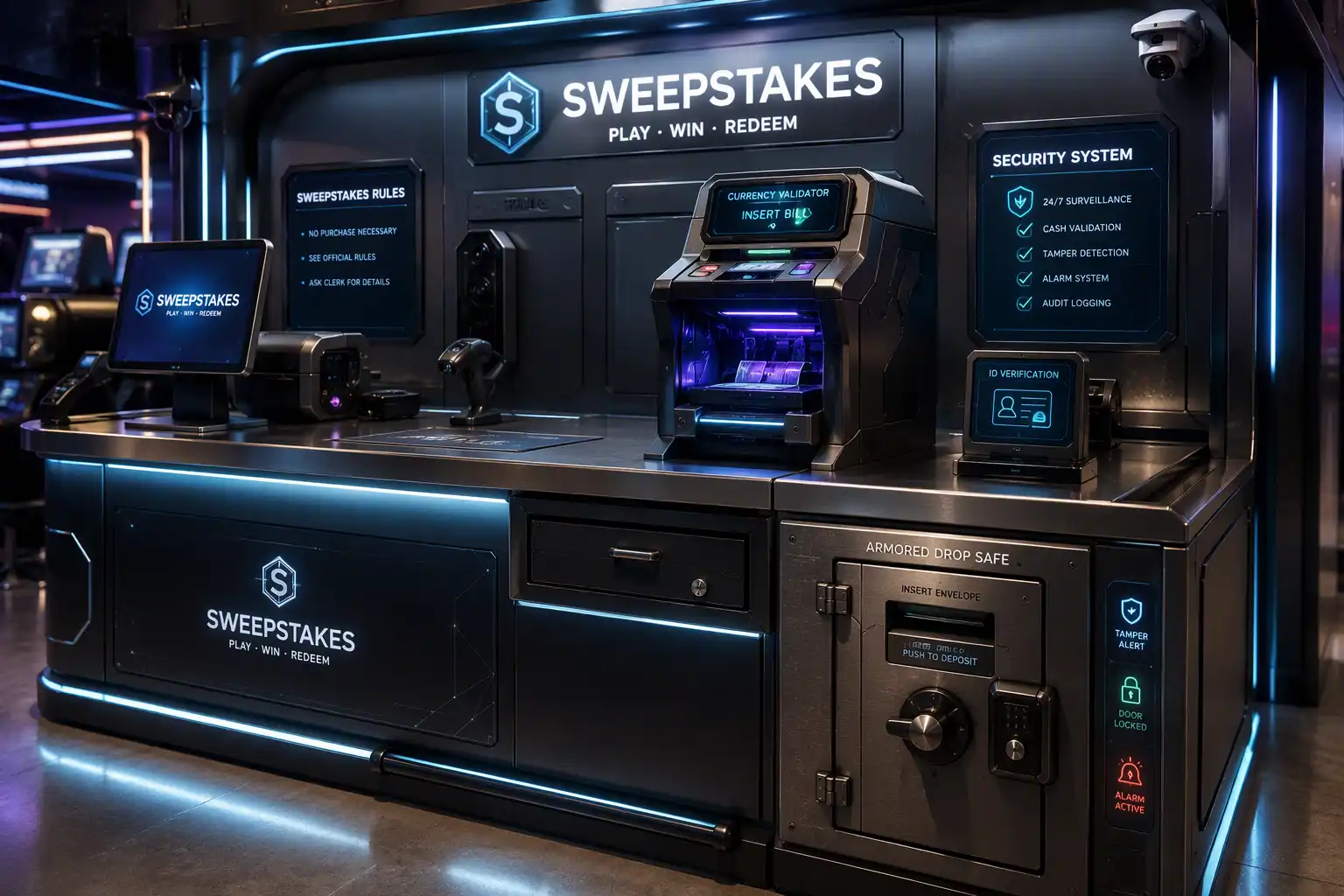
The High-Velocity Cash Risk Environment in Sweepstakes Venues
Unlike standard retail operations where digital credit cards represent 85% of transactions, sweepstakes arcades and fish game rooms operate predominantly in cash. A venue operating twenty gaming terminals routinely processes $15,000 to $40,000 in physical currency over a weekend. High transaction frequency combined with rapid player turnover creates fertile ground for operational leakage.
Industry loss prevention audits reveal that store margin leakage occurs across three primary vectors: internal employee skimming (42%), counterfeit currency acceptance (31%), and untracked drawer disparity / arithmetic errors (27%). Eliminating these losses requires replacing informal counter habits with structured, auditable Standard Operating Procedures (SOPs).
Counterfeit Currency Defense: Multi-Spectrum Scanning Protocols
Sophisticated counterfeit rings deliberately target busy sweepstakes venues during peak weekend night hours, betting that rushed cashiers will fail to inspect high-denomination bills ($50 and $100 notes). Relying solely on basic chemical iodine counterfeit detection pens is obsolete; modern bleached $1 bills reprinted as $100s easily pass chemical pen tests.
- Multi-Spectrum Motorized Bill Scanners: Equip every cashier terminal with commercial motorized bill validators featuring infrared (IR), magnetic thread (MG), ultraviolet (UV), and optical thickness sensors. Every $50 and $100 bill must be passed through the motorized validator before voucher points are loaded.
- Manual Verification Training: Train cashiers to check physical security features on 2013-series $100 bills: the 3D blue security ribbon with shifting bells and ‘100’ numerals, color-shifting ink on the copper inkwell, and microprinting along Benjamin Franklin’s collar.
- Counterfeit Confiscation SOP: If a counterfeit bill is detected, cashiers must immediately retain the bill, politely inform the patron that the bill failed multi-spectrum validation, and offer to inspect an alternative bill while logging the incident on security cameras.
Cash Drawer Float Caps and Two-Key Drop Safe Engineering
Keeping large amounts of cash in front-counter drawers exposes staff to armed robbery risks and tempts employee theft. Enforce a strict $1,000 Drawer Float Cap across all shifts.
| Cash Asset Category | Maximum Holding Limit | Storage & Hardware Security | Access Control & Authority |
|---|---|---|---|
| Active Register Drawer | $1,000 Maximum Cash Float | Under-counter locked steel drawer with micro-switch sensor | Single assigned shift cashier (PIN login) |
| Counter Drop Safe | $5,000 Accumulation Cap | Dual-custody rotary drop safe bolted to concrete subfloor | Drop slot: All staff; Opening: Manager + Cashier keys |
| Main Vault Reserve | Operational weekly cash float | TL-30 rated commercial safe with time-delay digital lock | Store Owner / General Manager exclusive PIN |
The Blind Shift-Close Protocol: Eliminating Internal Skimming
Never allow cashiers to perform shift reconciliations while viewing system-reported expected cash totals. When employees know the exact target balance, dishonest cashiers pocket overages or manipulate receipts to match the screen.
Implement the Blind Shift-Close Protocol:
- At shift conclusion, the outgoing cashier locks their terminal and removes their cash drawer to the secure counting room.
- The cashier physically counts all currency, rolls, and validated payout receipts, entering raw count quantities into a blank digital shift close form.
- Once submitted, the POS software compares the physical count against backend system voucher transactions, generating a disparity report.
- Disparities exceeding +/- $10 trigger an automated alert to the general manager and require immediate security camera audit.
Camera Topologies: Eliminating Blind Spots Over the Cash Desk
Deploy high-definition 4K security cameras positioned in a dedicated three-angle configuration over every cash station: Angle 1 (Direct Overhead 4K Lens) focused tightly on the cash drawer and bill counting tray; Angle 2 (Eye-Level Customer Facing) capturing patron facial identity; Angle 3 (Wide-Angle Room Overview) documenting staff movement between the register and drop safe.
Disparity Investigation and Disciplinary Protocols
Maintain an immutable employee Disparity Ledger. Track cumulative drawer variances per employee over 30-day windows. Enforce clear progressive disciplinary thresholds: initial variance review, formal written warning upon repeated >$20 discrepancies, and termination/reassignment upon persistent unexplained shortages.
Frequently Asked Questions
Why is chemical counterfeit detector pen testing insufficient for $100 bills?
Counterfeiters bleach genuine $1 and $5 bills and reprint $100 graphics over genuine rag paper. Chemical pens react to starch in real paper, giving false positive passes on bleached counterfeit notes.
What is the purpose of a blind cash count?
A blind cash count prevents employees from knowing the expected cash total, ensuring they cannot skim overages or falsify drawer totals to match system figures.
How often should cash drops from the register to the safe occur?
Cash drops should occur automatically whenever the register drawer total exceeds $1,000, or at minimum every two hours during busy shifts.
What is an acceptable cash drawer variance per shift?
In well-managed operations, drawer variance should remain below +/- $5.00 per shift. Any variance exceeding $10 requires supervisor review.
Related Resources for Sweepstakes Distributors and Store Owners
To further accelerate your operational performance and expand your agent distribution network, explore our comprehensive business frameworks and technical playbooks:
- MegaSpin Agent & Distributor Portal — Discover enterprise-grade software distribution, competitive commission structures, and multi-tier sub-agent management tools.
- Retail Sweepstakes Launch & Compliance Blueprint — Learn how top store owners optimize hardware selection, player onboarding, and regulatory compliance.