

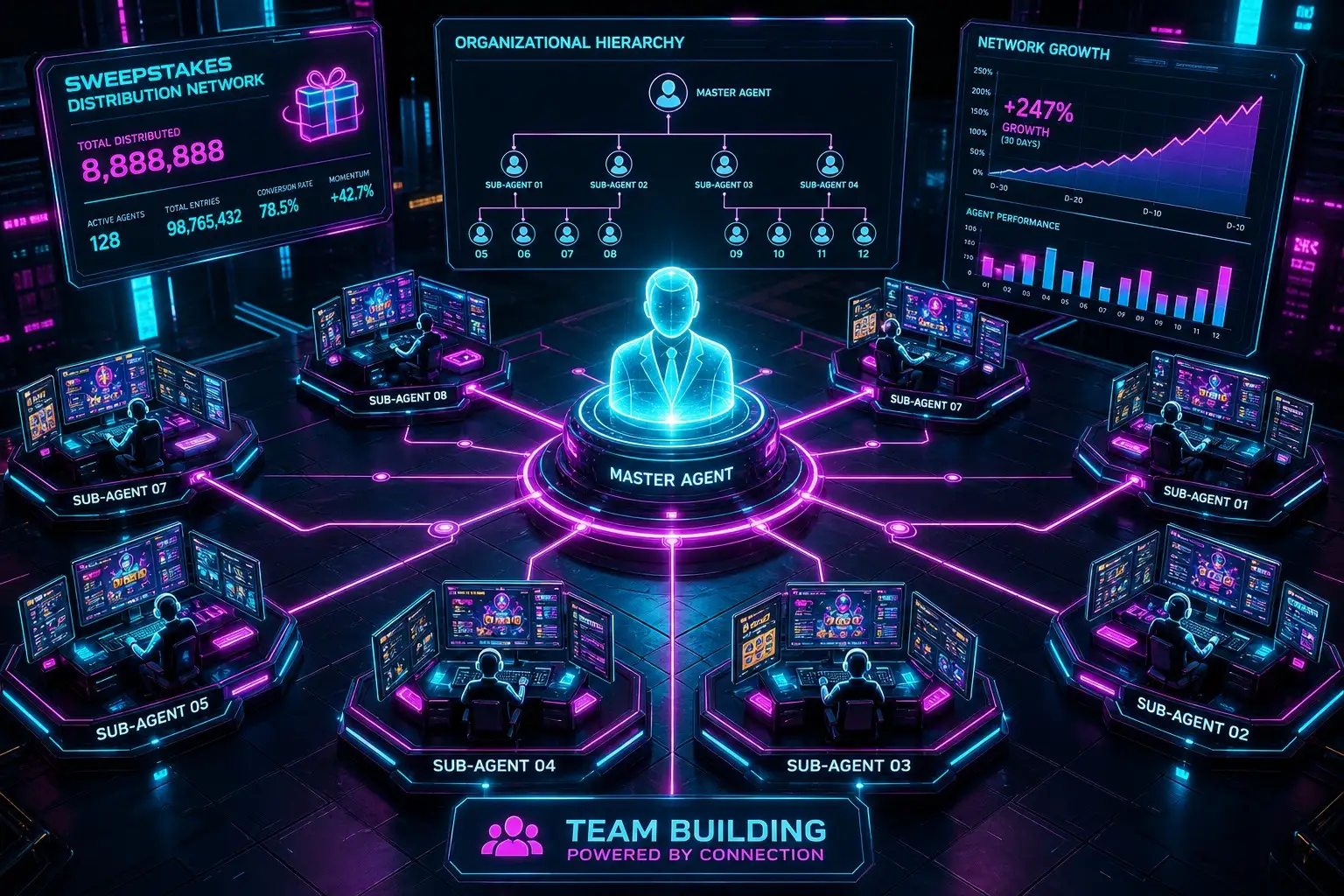
Every agent eventually confronts the same ceiling: your time. You can only personally manage so many players, so many credit loads, and so many support requests. Break through that ceiling requires a fundamental shift—from being the operator to building the team. The agents who build real wealth in 2026 are not the ones who work the most hours; they are the ones who built networks of trained, motivated sub-agents. This guide covers the complete journey of sweepstakes agent team building: recruiting the right partners, training them to perform, and keeping them loyal as your network grows.
Why Solo Agents Hit the Ceiling
The math of a solo operation is simple: your revenue is the product of your hours and your efficiency. Both have hard limits. You can load credits only so fast, respond to players only so quickly, and be present only so many hours per day. Beyond that ceiling, growth stops—not because the market lacks opportunity, but because one human cannot scale. The team model removes the ceiling: each trained sub-agent is a new operator running their own base under your network, and their growth multiplies yours without multiplying your hours.
Recruiting: The Profile of a Great Sub-Agent
Recruiting the wrong partners is worse than recruiting none. Look for a specific profile:
- Local market access: Sub-agents with existing communities—social groups, local networks, or customer bases—have a running start.
- Digital competence: They should be comfortable with mobile apps, social media, and basic financial tools. Training cannot fix digital illiteracy.
- Operational discipline: The best partners are reliable and process-oriented, not just enthusiastic. Enthusiasm fades; discipline compounds.
- Growth mindset: Partners who see the business as a career, not a side gig, invest the time to build it properly.
Where to find them: your own top players (who already understand the product), local business communities, and social media audiences who respond to your content. Your player base is the highest-converting recruiting pool you have.
Training: The Onboarding System
New sub-agents need a structured path from zero to productive. Build a repeatable training system:
- Platform orientation (Day 1): Master the dashboard, credit loading, and payout processing.
- Player acquisition (Days 2-3): Learn your proven recruitment scripts and marketing templates.
- Shadow period (Week 1): Run a small player base under your supervision before scaling.
- Independent operations (Week 2+): Full operating access with defined limits, reviewed weekly.
A documented training system means you can onboard partners repeatedly without reinventing the process each time. The system, not your personal effort, is what scales.
Compensation: Incentives That Work
Compensation design is the heart of team building. The goal is motivation without margin destruction:
- Tiered splits: Higher-volume sub-agents earn better rates, incentivizing growth while keeping your base margin protected.
- Volume milestones: Bonus thresholds reward consistent performance, not one-off bursts.
- Quality incentives: Reward retention and low chargeback rates, not just raw volume. This aligns their behavior with your long-term health.
Transparent, published compensation is essential. Partners who understand exactly how they earn are motivated; partners who distrust the math will leave.
Retention: Keeping Your Best Partners
Your best sub-agents will be courted by other networks. Retain them by being the best partner they can find:
- Fast support: When a partner hits a problem, your response time determines their loyalty. Be faster than the competition.
- Growth opportunities: Offer paths to higher tiers, more independence, and recognition. Ambitious partners stay where they can grow.
- Consistent communication: Regular check-ins, market updates, and strategy calls make partners feel like part of a team, not a transaction.
Case Pattern: From Solo Agent to 15-Partner Network
The transformation from solo agent to network leader follows a recognizable pattern in successful 2025-2026 operations. Consider an agent who had run a solid solo business for two years, managing roughly 200 players personally. The operator’s growth had flatlined because every additional hour of work yielded diminishing returns. The breakthrough came from a deliberate decision to recruit from an unexpected source: the operator’s own player base. The top players—those who already understood the games, the community, and the appeal of the product—were the natural first partners.
The first two sub-agents were top players who had asked about “getting involved.” The operator formalized the arrangement with a transparent tiered compensation structure and a documented training path. The onboarding system proved its worth: each new partner moved from zero to independently operating their own base within two weeks, using the same scripts and dashboards the operator had refined. Because the partners were drawn from the player community, they brought their own social networks, which became instant acquisition channels.
The network grew to 15 partners over eighteen months, each running their own base under the master network. The operator’s role shifted from loading credits to governing: training, supporting, and reviewing weekly partner performance. Revenue grew several-fold while the operator’s working hours actually decreased. The key insight from the pattern is sequence: the operator first built a repeatable training system, then recruited, then scaled. The system—not the operator’s personal effort—is what made the network possible.
Why Teams Multiply Everything
Team building is the difference between earning income and building equity. A solo agent’s operation is tied to their personal hours; a network’s value grows even when the leader steps back. Teams multiply reach, resilience, and reputation: many partners serve more players, survive the loss of any single operator, and expand the brand’s footprint through their own communities. The business you can sell, partner with, or scale is the business built on a team, not on one person’s effort.
Frequently Asked Questions
How many sub-agents should I start with?
Start small: two to three carefully chosen partners. Prove the training and compensation system with them, refine it, then scale. Quality of partners matters far more than quantity, especially in the early stages.
How do I prevent sub-agents from taking players elsewhere?
You cannot fully prevent it, but you can make it unappealing: strong support, fair compensation, and a partnership that genuinely benefits them. Also structure your network so relationships are visible and recognized—players know their network, not just their immediate agent.
How do I structure compensation so it is fair and motivating?
Use published, tiered splits tied to volume and quality metrics. Higher volume earns better rates; retention and low chargebacks earn bonuses. Transparency is essential—partners must understand exactly how they earn. Review the structure quarterly and adjust it as your network economics evolve.
How do I handle a sub-agent who underperforms?
Diagnose before you judge. Review their weekly numbers and training completion; the cause may be a fixable gap rather than a lack of effort. Intervene with targeted coaching, set a clear improvement period with measurable targets, and document the process. If performance does not improve, transition them out professionally, protecting your network’s reputation and your other partners’ trust.
What role should I keep for myself as the network grows?
Keep the roles only you can perform: partner recruitment, high-value coaching, compensation governance, and network-level strategy. Delegate everything operational to sub-agents and the platform’s automation. The leader who tries to do everything becomes the bottleneck; the leader who delegates becomes the multiplier.
Do I need formal agreements with my sub-agents?
Yes. A written agreement covering compensation, territory, data ownership, and conduct protects both sides and professionalizes the relationship. It prevents the disputes that end partnerships. The agreement need not be complex; it must be clear and mutually understood.
What are the signs of a sub-agent who will fail?
Red flags include: overpromising without action, resistance to training, careless handling of credits, and a focus on quick wins over sustainable operations. Intervene early with coaching; if behavior does not change, replace them before they damage your network’s reputation.
Building the Network Operating Cadence
A network of partners needs a rhythm to stay aligned and motivated. Establish a weekly cadence: a Monday performance review of each partner’s numbers, a mid-week support window for questions and coaching, and a Friday recognition moment that celebrates wins publicly. Monthly, hold a full network call to review strategy, share what is working, and announce any compensation or tooling updates. This cadence keeps partners engaged, informed, and progressing—and it gives you the visibility to intervene early when any partner drifts. The network that runs on rhythm compounds; the network that runs on hope fractures.
Conclusion: The Team Is the Business
Solo operation builds an income; team building builds an enterprise. The agents who lead the 2026 market are the ones who understood that their real asset is not their player list—it is their network of trained partners. Recruit the right profiles, train them with a repeatable system, compensate them transparently, and retain them with superior partnership. Your team’s growth becomes your growth, and the ceiling disappears. Stop working in your business and start building it.
Ready to build your network? The MegaSpin platform supports sub-agent hierarchy, tiered splits, and per-agent reporting to power your team model.