

Most sweepstakes agents obsess over one number: how many new players they can recruit this week. The smartest agents obsess over a different number: how many players from last month are still playing today. The math is brutal and beautiful at the same time. Acquiring a new depositing player costs roughly five times more than keeping an existing one, and a retained player deposits three times more over their lifetime than a one-session visitor. In 2026, the competitive advantage in the fish game market is no longer who can run the loudest promotion; it is who can build the most effective player retention engine. This guide shows sweepstakes agents exactly how to do it.
Why Agents Lose Players (And It Is Not the Game)
Before building a retention engine, you must understand why players leave. Across hundreds of agent networks analyzed in 2025-2026, the same five causes appear with remarkable consistency. None of them is “the game is boring.” The causes are operational and relational:
- Slow Payouts: A player who wins and waits three days for their cash is a player who is already mentally gone. Speed is trust.
- Generic Bonuses: A daily bonus that never changes trains players to treat it as background noise, not an incentive.
- No Recognition: A high-volume player treated identically to a casual player will find an agent who recognizes their value.
- Silence After Losses: The period immediately after a big loss is when players churn. Agents who stay silent lose them.
- Technical Friction: A single failed credit load or login error on a mobile device can erase weeks of goodwill.
Notice that every cause is within the agent’s control. That is the empowering reality of retention: it is a discipline you can implement, not a fate you suffer.
Building the Retention Engine: Four Core Systems
1. The VIP Loyalty Ladder
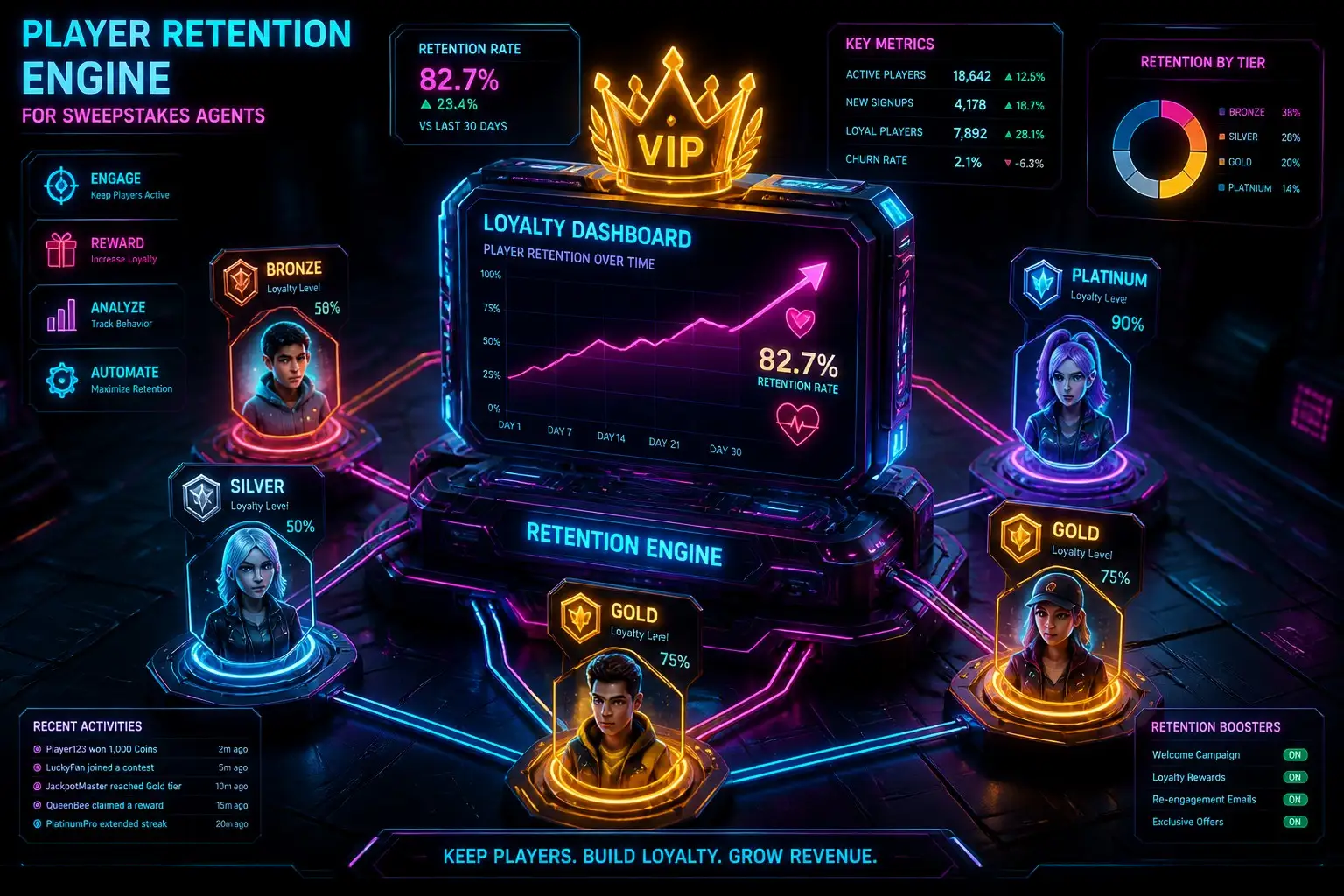
The single highest-impact retention tool is a transparent tier system. Create four tiers based on cumulative volume: Bronze, Silver, Gold, and Platinum. Each tier carries concrete, escalating benefits: faster payout priority, higher reload bonuses, exclusive access to private tournament rooms, and a dedicated agent contact. The ladder gives every player a visible “next rung” to climb, converting passive play into goal-directed behavior. Agents who implement tiered loyalty report average deposit sizes increasing by 35-45 percent within two months, because players actively work to maintain or reach the next tier.
2. Behavioral Churn Detection
You cannot retain a player you cannot see leaving. A modern master dashboard provides behavioral telemetry that flags “at-risk” patterns: declining session frequency, dropping average stake size, skipped login streaks, and post-loss withdrawal behavior. Set automated alerts so you know which players need attention before they vanish. The key is acting within 48 hours of the first negative signal, when a simple outreach can still reverse the decision to quit.
3. The Comeback Playbook
When a player goes dormant, structured re-engagement works dramatically better than a generic “we miss you” message. Build a staged playbook: Day 1, a personal note referencing their favorite game; Day 3, a targeted reload credit with a clear expiry; Day 7, an invitation to a private event or a higher loyalty tier trial. Each stage has a measurable conversion rate, and the playbook compounds because each stage feeds the next. Agents running staged comeback campaigns recover 20-30 percent of dormant players within 30 days.
4. Community Infrastructure
Retention becomes self-sustaining when players retain each other. Build a private community (Telegram, WhatsApp, or Discord) where your active players gather: win shootouts, daily credit drops, and friendly competition. Players who belong to a community are dramatically less likely to churn, because leaving means leaving the group, not just a game. The community also becomes your cheapest acquisition channel, as members invite their own networks.
The Economics of Retention: Real Numbers
Let us model the difference. An agent with 200 one-time players at a $100 average deposit earns $20,000 in one-off revenue. An agent with 80 retained players who deposit four times a year at $150 each earns $48,000 annually, with acquisition costs near zero after the first month. The retained base compounds: satisfied players refer, referrals become loyal players, and the engine feeds itself. This is why retention is not a “nice to have” in 2026; it is the primary economic engine of a successful agent operation.
Implementation Checklist for Agents
- Audit your payout speed: If redemption take longer than 24 hours, fix the process before anything else. Speed is the foundation.
- Define your tier thresholds: Set Bronze-to-Platinum volume levels that are ambitious but achievable for your player base.
- Enable churn alerts: Configure your dashboard to flag declining engagement patterns automatically.
- Write your comeback scripts: Draft the Day 1, Day 3, and Day 7 messages before you need them.
- Launch your community: Create your private group and seed it with your top 20 players.
Case Pattern: How One Agent Turned Retention Into Growth
To make the framework concrete, consider the operational pattern observed across a successful agent network in 2025-2026. The operator ran a mid-sized player base of roughly 300 depositing players, acquired mainly through local social media and referrals. Growth had plateaued: new players joined, but nearly as many churned each month, leaving the operation running in place. The agent’s first instinct, like most, was to increase acquisition spend. The data told a different story.
When the operator enabled behavioral telemetry on the master dashboard, the churn pattern became visible immediately. More than 60 percent of departing players shared one trait: they had experienced a payout delay of more than 24 hours in their first two weeks. The agent’s payout process, which relied on manual batch settlement, was the retention killer. The fix was operational: moving to an automated payout flow with 24-hour guaranteed settlement. Within six weeks, the churn rate among new players dropped by nearly half, without a single dollar spent on acquisition.
The second intervention was the loyalty ladder. The agent defined four volume tiers with escalating benefits, including priority payouts and exclusive tournament access. Within two months, average deposit size among tiered players increased by roughly 40 percent, because players actively worked to maintain their tier status. The agent’s total GGR grew by 32 percent in one quarter, driven almost entirely by retention improvements rather than new acquisition. The lesson generalizes: the highest-ROI growth lever available to most agents is not finding more players, but keeping the ones they already have.
Frequently Asked Questions
Do loyalty tiers reduce my profit margin?
No. The incremental cost of a reload bonus is far smaller than the cost of acquiring a replacement player. The increased deposit volume from tiered players more than offsets the bonus expense. Track your “cost per retained player” versus “cost per new player” and the math becomes obvious within one quarter.
How do I know which players are worth retaining?
Focus on players with consistent deposit behavior over 30-plus days, regardless of win/loss. A player who deposits regularly but loses is still generating volume for your network; a player who wins big and stays is your best advertiser. The dashboard’s volume segmentation tells you exactly who falls into each category.
How often should I review my retention metrics?
Weekly is the right cadence for actionable review. Daily looks are noise; monthly is too slow to intervene. Each week, review three numbers: active player count, churn rate among your top 20 percent of players, and average deposit size. A weekly review catches negative trends while they are still small enough to reverse.
Should I reward players for bringing friends?
Yes, with discipline. A referral credit—typically 10-15 percent of the friend’s first deposit—turns your existing players into a recruitment channel. The key is structuring it as a bonus that rewards the referrer only after the friend becomes active, preventing referral fraud and ensuring the economics work.
Is retention harder for online-only agents than storefront agents?
Online agents actually have an advantage: richer behavioral data and direct messaging channels. Without physical interaction, you must compensate with faster communication and more visible recognition, but the tools to do so are fully available in the digital ecosystem.
Conclusion: Build the Engine, Not Just the Game
The fish game market of 2026 rewards agents who think like operators, not like ticket sellers. A player retention engine is the difference between a business that churns through players and a business that compounds them. The systems are proven, the tools are in your dashboard, and the economics are unambiguous. Build your loyalty ladder, watch your churn signals, and make every player feel like a VIP. The players who stay are the players who grow your network, and they are waiting for you to start.
Ready to build your retention engine on a platform that supports it? Contact the MegaSpin agent team to see how our dashboard enables tiered loyalty, churn alerts, and instant payouts.